Play Range puzzle (black cells) (Range) online Works — plays right here, unlimited puzzles
Guide updated October 2026 · Runs via WebAssembly (native port)
Range is a shading puzzle: blacken some squares so that each number can see exactly that many white squares, counting itself, along its row and column. Black squares may not touch side by side, and the white squares must stay in one connected piece. Nikoli publishes it as Kurodoko. The puzzle is ready below; click a square to blacken it.
Controls — what does what
| Action | Keyboard | Mouse / touch |
|---|---|---|
| Blacken a square (cycles black, dot, empty) | Arrow keys to move, Enter | Left-click |
| Mark a square as white with a dot | Space | Right-click |
| Dot several squares | Shift+arrow | — |
| Undo / redo | U / R (or Ctrl+Z / Ctrl+R) | Game menu buttons |
FREE This is the complete game, free. Open source under the MIT licence: the complete puzzle, with a new grid every time.
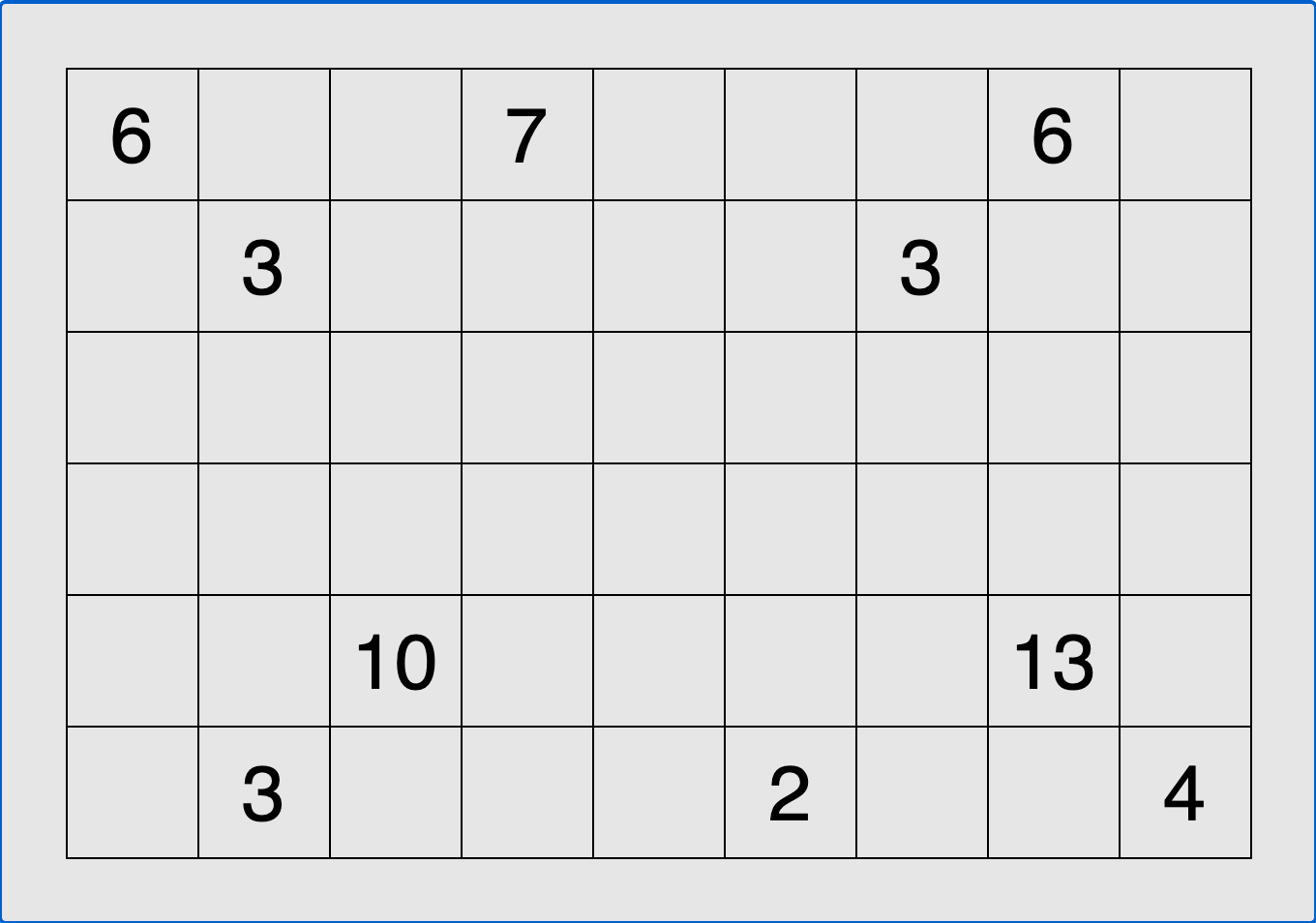
Range is from Simon Tatham's Portable Puzzle Collection, © Simon Tatham and contributors, used under the MIT licence. Built from source by scripts/build-puzzles.mjs.
How to play
- Squares with numbers are never black.
- No two black squares share a side.
- All white squares connect to each other through sides.
- Each number equals the count of white squares visible from it in the four straight directions until a black square or the edge, including itself once.
Sizes and difficulty
Presets are 9×6, 12×8, 13×9 and 16×11. Custom allows any width and height.
Solving tips
A 2 sees itself plus exactly one other square, so at most one of its neighbours can be white. Large numbers in a short row or column force whites far along the line. Every square next to a black square is white, and a black square that would cut off a white region from the rest is not allowed. There is never a 1, since it would need four black neighbours and be cut off.
Where this puzzle comes from
Range is part of Simon Tatham's Portable Puzzle Collection, a set of about forty logic puzzles written by Simon Tatham and contributors and released under the MIT licence. Every grid is generated on the spot, so the supply never runs out, and for the grid-logic puzzles the generator makes sure each has exactly one solution, reachable by reasoning rather than guessing. The version here is the collection's own code compiled to WebAssembly; the Game menu can save a puzzle to a file and load it again, and the Type menu changes the size and difficulty.
Frequently asked questions
Why is there never a 1?
A 1 would need all four neighbours black, which would isolate it from every other white square and break the connection rule.
Does the numbered square count itself?
Yes, once. A 5 sees four other white squares in total, in whatever mix of directions.
Is Range free to play here?
Yes, with no limit on the number of puzzles. Range is open-source software under the MIT licence, and every grid is generated fresh when you press New game.
Does it work on a phone or tablet?
Yes. A tap works as a click and the puzzle resizes to fit the screen. Puzzles whose controls use the right mouse button are easier with a mouse.
More you can play in your browser

Related guides
- Light Up puzzle (Light Up)Play Light Up free in your browser: place bulbs so every white square is lit, no bulb shin
- Mosaic puzzle (Mosaic)Play Mosaic free in your browser: shade squares so every clue matches the number of black
- Number shading puzzle (Singles)Play Singles free online: shade squares so no number repeats in a row or column, shaded…
- Nonogram (Pattern)Play nonograms free in your browser: shade the grid so each row and column matches its run
Want a game like this on your own site?
Range puzzle (black cells) (Range) isn't ours to give away — we host it, we didn't write it. But eleven of the games here we did write from scratch, and those are free for anyone to put on their own page: one line of HTML, no account, no permission, no attribution beyond a credit line.