Play Flood fill colour puzzle (Flood) online Works — plays right here, unlimited puzzles
Guide updated October 2026 · Runs via WebAssembly (native port)
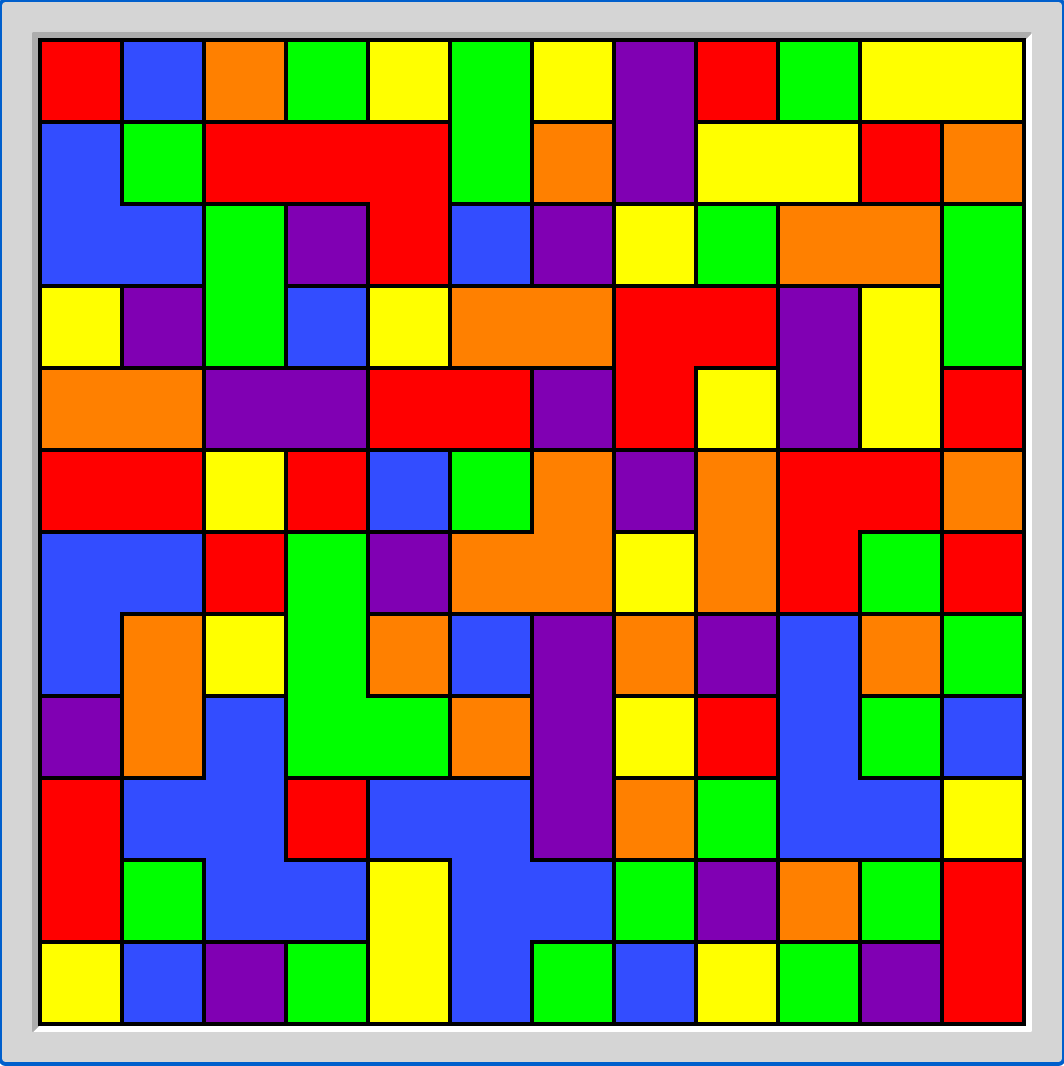
Flood is a colour puzzle: each move repaints the top-left region of the grid in a colour you choose, swallowing every touching square of that colour. Keep going until the whole board is one colour, without running out of moves. The puzzle is ready below; click a square of the colour you want to flood with next.
Controls — what does what
| Action | Keyboard | Mouse / touch |
|---|---|---|
| Flood with a colour | Arrow keys to a square, then Enter | Left-click any square of that colour |
| Undo / redo | U / R (or Ctrl+Z / Ctrl+R) | Game menu buttons |
| Show a solution | — | Game menu → Solve |
FREE This is the complete game, free. Open source under the MIT licence: the complete puzzle, with a new grid every time.
Flood is from Simon Tatham's Portable Puzzle Collection, © Simon Tatham and contributors, used under the MIT licence. Built from source by scripts/build-puzzles.mjs.
How to play
- The grid starts as a random patchwork of colours.
- Each move changes the colour of the top-left square and every square joined to it through the same colour; neighbours already in the new colour join the region.
- You win by making the whole grid one colour in no more moves than the limit shown.
The limit comes from the game's own solver plus any extra moves the difficulty allows.
Sizes and difficulty
Presets are 12×12 at Easy, Medium and Hard, 16×16 at Medium and Hard, and 12×12 boards with only 3 or 4 colours. Difficulty only changes the move allowance: Hard gives you exactly as many moves as the game's solver needed. Custom allows 3 to 10 colours.
Solving tips
Choose the colour that adds the most squares, but look one move ahead: grabbing a colour that opens a long corridor into the far side of the board is often worth more than a bigger nearby blob. Aim to reach the board's centre early, since growing from the middle touches more squares each turn. Near the end, clear colours one at a time, so each remaining colour costs exactly one move.
Where this puzzle comes from
Flood is part of Simon Tatham's Portable Puzzle Collection, a set of about forty logic puzzles written by Simon Tatham and contributors and released under the MIT licence. Every grid is generated on the spot, so the supply never runs out, and for the grid-logic puzzles the generator makes sure each has exactly one solution, reachable by reasoning rather than guessing. The version here is the collection's own code compiled to WebAssembly; the Game menu can save a puzzle to a file and load it again, and the Type menu changes the size and difficulty.
Frequently asked questions
How is the move limit decided?
The game solves each board itself and adds the difficulty's allowance of extra moves. On Hard you must match its solver; it is not always optimal, so you can sometimes beat it.
Does clicking the current colour use a move?
No. Choosing the colour the top-left region already has does nothing and is not counted.
Is Flood free to play here?
Yes, with no limit on the number of puzzles. Flood is open-source software under the MIT licence, and every grid is generated fresh when you press New game.
Does it work on a phone or tablet?
Yes. A tap works as a click and the puzzle resizes to fit the screen. Puzzles whose controls use the right mouse button are easier with a mouse.
More you can play in your browser

Related guides
- Same GamePlay Same Game free in your browser: remove groups of same-coloured blocks to clear the bo
- JezzBallBuild walls, trap the balls, clear 75% of the field. The Entertainment Pack classic.
- Block DropSeven shapes, a ten-wide well, and a four-row clear worth eight times a single.
- Mosaic puzzle (Mosaic)Play Mosaic free in your browser: shade squares so every clue matches the number of black
Want a game like this on your own site?
Flood fill colour puzzle (Flood) isn't ours to give away — we host it, we didn't write it. But eleven of the games here we did write from scratch, and those are free for anyone to put on their own page: one line of HTML, no account, no permission, no attribution beyond a credit line.